Hooked Fishing Lure Sticker Design
A Designer’s First Glance: Clean, Nostalgic, and Instantly Recognizable
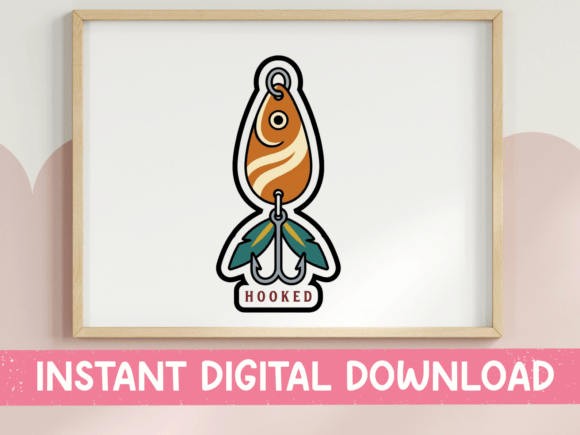
When I opened Hooked Fishing Lure Sticker Design, my eye landed first on the balance—how the tan-and-amber lure floats effortlessly from its top hook, with that bold teal triple treble hook anchoring the bottom. It’s not fussy, but it’s not generic either. There’s a quiet confidence in the swirls inside the lure body—just enough detail to read as handcrafted, not clipart. As a designer who’s stitched hundreds of fishing-themed pieces for Etsy sellers and boutique apparel brands, I immediately thought: This isn’t just a graphic—it’s a conversation starter. It leans into nostalgia without leaning too hard, and it carries the kind of visual clarity that translates well across embroidery formats—not just screen prints or digital graphics, but real thread-on-fabric execution.
Where This Design Truly Shines (and Why Your Customers Will Notice)
I recently used Hooked Fishing Lure Sticker Design as the centerpiece for a custom embroidered tote bag—intended for a local fly-fishing guide service launching summer gear. On medium-weight canvas, with a light tear-away stabilizer and 40-weight rayon thread, the design held up beautifully. The lure’s curved shape stitched cleanly; the swirls resolved without bleeding or distortion. Most importantly? Clients paused mid-conversation to point at it. “That’s *exactly* the old Rapala my dad used,” one said. That kind of recognition is gold—it builds trust, reinforces authenticity, and turns a simple tote into a shared memory.
It works especially well on sweatshirt embroidery and baby embroidery where subtlety matters: scaled down to 3.2 inches tall, it reads clearly on a onesie chest without overwhelming the garment. On tea towels and aprons, the teal treble hook pops against natural linen or oatmeal cotton—no need for heavy fill stitches to carry the visual weight. And because it’s built as a clean T-Shirt Designs graphic first, the vector-like simplicity means it converts smoothly to an applique design or even a layered satin-stitch patch.
Real Embroidery Considerations: What You’ll Want to Test First
Before committing to production, here’s what I always check—and what you should too:
- Stitch density: The swirls inside the lure suggest moderate fill stitch use—not overly dense, but not sparse either. On textured fabrics like terry cloth or fleece, test a small sample to confirm definition holds.
- Hoop size & placement: Because the design is vertically oriented and relatively narrow, it fits comfortably in a 4×4 hoop—but avoid pushing it too close to seam allowances on curved surfaces like caps or pillow covers.
- Thread colors: The amber/tan/teal palette is versatile, but contrast drops on dark fabric. I recommend testing black-and-white mockups first, especially if you’re listing this as a digital embroidery file for others to use.
- Fabric compatibility: Avoid thin or highly stretchy knits unless paired with cutaway + topping stabilizer—the hook curves and fine lure edges can pucker or distort otherwise.
What This Design Says About Your Brand—Without a Word
Using Hooked Fishing Lure Sticker Design in your craft business tells customers you value specificity over sameness. It signals attention to subculture cues—anglers know a triple treble hook when they see one—and that kind of accuracy builds credibility fast. For Etsy sellers, it elevates a basic embroidered patch from “cute” to “curated.” For small shop products like holiday embroidery or personalized gifts, it adds narrative weight: imagine it stitched onto a rustic wooden ornament or a navy blanket for a fishing-themed nursery. It doesn’t shout—it invites. And that makes it unusually effective for commercial embroidery where brand consistency matters more than flash.
Practical Notes Every Embroidery Designer Should Keep Handy
Before stitching Hooked Fishing Lure Sticker Design into a finished product—or listing it as a digital embroidery file—do these five things:
- Run a test on scrap fabric matching your final substrate (e.g., twill for caps, jersey for tees).
- Compare thread color options side-by-side on both light and dark backgrounds using printable mockups.
- Zoom in on corners and curves in your embroidery software—confirm no tiny running stitch details are lost at scale.
- Verify stabilizer choice: light tear-away for stable wovens, cutaway + topping for knits or nap-heavy fabrics like fleece.
- Double-check licensing terms—especially if you plan to sell physical embroidered patches or include it in a bundle of design assets for other makers.
Final Thought: A Quiet Workhorse, Not a Flashy Gimmick
Hooked Fishing Lure Sticker Design won’t dominate a tradeshow booth, but it will earn repeat orders from customers who care about authenticity and craftsmanship. It’s the kind of Graphics asset that grows more valuable the longer you own it—because it fits so many contexts: a subtle logo on a boutique apron, a bold statement on a dad’s trucker cap, a tender detail on a baby’s first fishing-themed onesie. It’s designed for real life, not just ideal conditions. And in embroidery—where thread tension, fabric movement, and customer expectations all converge—that’s the highest compliment a designer can give.