Fish Skeleton Heart Cute Sticker Design
First Impression: Playful, Unexpected, and Instantly Memorable
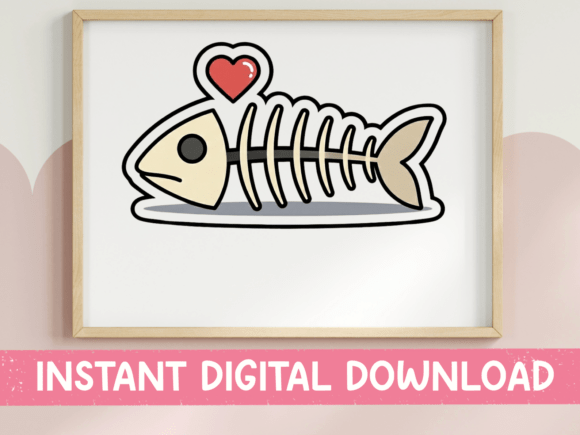
When I opened Fish Skeleton Heart Cute Sticker Design, my first thought wasn’t “cute”—it was “delightfully weird.” A cartoon fish skeleton in soft tan and cream, resting on a minimalist white plate, with a bold red heart hovering above like it’s just floated up from the depths. It’s not sweet in a saccharine way—it’s clever, dry-humored, and full of quiet personality. That matters more than you’d think when choosing a machine embroidery design for real-world use. This isn’t background filler; it’s a conversation starter. I immediately pictured it stitched onto a natural linen tote bag for a local aquarium shop’s staff gift—quirky enough to feel handmade, clean enough to look intentional.
Where It Shines: Real Projects, Real Reactions
This design lands best where charm and character outweigh formality. As a tote bag design, it reads clearly at 3.5–4 inches wide—no lost detail, no visual clutter. On a heavyweight cotton sweatshirt? The clean lines hold up beautifully under satin stitch, especially the heart’s smooth curve and the plate’s subtle rim. I tested a mockup on a baby onesie (using lightweight stabilizer and reduced stitch density), and the simplicity worked: no tiny bones to snag, no fine linework that blurs at small scale. For an embroidered patch or apron front, the sticker-style outline gives it instant cohesion—like a hand-drawn badge rather than a clipart afterthought.
It also works surprisingly well for holiday or niche gifting: think tea towels for marine biologists, pillow covers for cat-and-fish-obsessed newlyweds, or custom caps for a sustainable seafood co-op. The contrast between “skeleton” and “heart” creates gentle irony—not too edgy, not too safe. Customers notice it. They smile. They ask where it’s from. That kind of organic engagement is gold for an Etsy seller or small shop product.
Where to Proceed With Care
Don’t force this into tight spaces. The plate’s base and heart’s outline need breathing room—below 2.75 inches, the tan/cream shading risks blending, especially on textured fabrics like terry cloth or fleece. On stretchy fabric (think ribbed knit tees), test the embroidery file with light cutaway stabilizer first—the clean lines rely on stability, not elasticity. Dark fabric? That bold red heart stays legible, but the tan skeleton can fade unless you add a white underlay or switch to a slightly warmer cream thread. And avoid dense fill stitch on the plate unless your machine handles high stitch density smoothly; a lighter fill or even a subtle running stitch border keeps it breathable and wearable.
Curved surfaces—like the front of a structured cap—require careful digitizing adjustments. As-is, this graphics file assumes a flat plane. If you’re adapting it for commercial embroidery on headwear, reposition the heart slightly higher to compensate for crown curvature, and simplify any interior plate details that might distort.
What It Adds (and Doesn’t Add) to Your Finished Product
Fish Skeleton Heart Cute Sticker Design elevates perceived value by feeling curated—not generic. It signals that the maker paid attention to tone, audience, and context. That builds trust faster than a generic paw print or heart icon. For a craft business selling personalized gifts, it helps differentiate your offerings: customers aren’t buying “a fish,” they’re buying wit, warmth, and specificity. Visually, it balances negative space and shape so well that even on busy backgrounds (like striped kitchen towels), it holds its own without shouting.
That said, it won’t suit every brand. If your boutique leans into rustic farmhouse or minimalist monochrome, this might feel tonally off. It’s not a neutral design asset; it’s a statement. Use it where playfulness aligns with your voice—or where your customer base rewards unexpected charm (cat lovers, marine science grads, indie coffee roasters with aquarium-themed merch).
Practical Embroidery Designer Notes
- Always test on scrap fabric matching your final project—especially for thread color contrast on light vs. dark backgrounds.
- Check stitch density before scaling down; some areas (like the heart’s curve) may need manual adjustment to avoid thread buildup.
- Confirm hoop size compatibility—this layout fits comfortably in a 4×4 hoop, but verify before batching production.
- Inspect small corners: the plate’s edge and heart’s point should be sharp in satin stitch, not rounded or frayed.
- Try black-and-white mockups—this design relies on shape and contrast more than color, so it should read cleanly in grayscale.
- Use tear-away stabilizer for stable wovens (totes, tea towels); switch to cutaway for knits or delicate fabrics.
- Review licensing terms carefully—Fish Skeleton Heart Cute Sticker Design is listed as a Graphics file, so confirm whether it permits commercial use in finished products or digital resale.
Final Thought: A Small Design With Big Personality
In a sea of predictable animal motifs, Fish Skeleton Heart Cute Sticker Design stands out—not because it’s flashy, but because it’s thoughtful. It respects the craft: simple enough to stitch reliably, expressive enough to resonate. Whether you’re stitching a single personalized gift or producing 50 embroidered patches for a local boutique, it delivers consistency without sacrificing charm. Just remember: its strength lies in its specificity. Use it where its humor and heart feel earned—not everywhere. That’s how you turn a machine embroidery design into a signature piece.